
Find Washington Bankruptcy Records
Washington bankruptcy records are public federal case filings held by the U.S. Bankruptcy Courts for the Western and Eastern Districts of Washington. The state's 39 counties are split between two federal court divisions, each with its own courthouse and records system. You can search bankruptcy records online through PACER, check basic case details toll-free by phone, or visit a public terminal at a courthouse. This guide covers where to find bankruptcy records in Washington, how to use each access method, and what resources are available to help you through the process.
Washington Bankruptcy Records Overview
Washington Bankruptcy Records by Federal District
Washington uses two federal bankruptcy districts. Which one handles your case depends on where you live. Counties west of the Cascade Mountains fall under the Western District. Counties to the east fall under the Eastern District. Both courts follow federal law under Title 11 of the United States Code, but each has its own offices and filing systems.
The U.S. Bankruptcy Court for the Western District of Washington covers 19 counties including King, Pierce, Snohomish, Clark, Thurston, Kitsap, Whatcom, Skagit, Cowlitz, and Grays Harbor. The court runs two locations. The Seattle office is at 700 Stewart Street, Suite 6301, Seattle, WA 98101, phone 206-370-5200. The Tacoma office is at 1717 Pacific Avenue, Suite 2100, Tacoma, WA 98402, phone 253-882-3900. Neither office accepts cash. You can pay filing fees online through Pay.gov using a debit card, PayPal, or ACH transfer. Free public access terminals are available in each Clerk's Office lobby so you can view case records without a PACER account.
The U.S. Bankruptcy Court for the Eastern District of Washington covers 20 counties including Spokane, Yakima, Benton, Franklin, Adams, Grant, Chelan, Walla Walla, and Whitman. The main office is at 904 West Riverside Avenue, Suite 304, Spokane, WA 99201, phone 509-458-5300. Hours are Monday through Friday, 8:30 a.m. to 4:30 p.m. Mail goes to P.O. Box 2164, Spokane, WA 99210-2164. The Yakima satellite office at 402 East Yakima Avenue, Suite 200, is open by appointment only. The court also holds hearings in Richland for Tri-Cities residents.
Both districts fall under the oversight of the U.S. Trustee Program, a Department of Justice component that monitors cases for fraud and supervises private trustees. The Seattle U.S. Trustee office is at 1000 Second Avenue, Suite 2500, Seattle, WA 98104. The Spokane office is at 920 W. Riverside Ave., Suite 593, Spokane, WA 99201. If you suspect fraud in a Western Washington bankruptcy case, the hotline is (253) 353-2999. For Eastern Washington, call (509) 353-2999.
How to Search Bankruptcy Records Online
Washington bankruptcy records are held in federal electronic case files. Three main access methods are available: the PACER online database, a free phone line, and public terminals at each courthouse. Each gives you a different level of detail and convenience.
PACER (Public Access to Court Electronic Records) is the primary tool for searching federal bankruptcy records from home. It gives you 24/7 access to case documents, docket entries, and filing history for both Washington districts. PACER charges $0.10 per page for case information. The fee for viewing one document is capped at $3.00. If your total use in a quarter is under $30, the fee is waived entirely. Around 75% of PACER users do not pay any fee in a given quarter. You can register free at pacer.gov/register.html or call 800-676-6856. Providing a credit card gets you immediate access. Without one, login info arrives by U.S. mail within 7 to 10 business days.
The Voice Case Information System (VCIS) at 866-222-8029 gives you free automated case data 24 hours a day with no account needed. The system reads you case number, filing date, debtor name, trustee, and current status. It covers both districts.
The Washington State Courts Name and Case Search covers municipal, district, superior, and appellate courts statewide but does not include federal bankruptcy cases. Use this portal when you need state court records alongside your bankruptcy search. The Odyssey Portal covers Superior Court case information in 37 of Washington's 39 counties and is another free resource for state-level records.
The Washington Courts Name and Case Search is free to use and pulls data from most county courts across the state.
Washington's statewide courts case search portal provides public access to records from courts across all 39 counties at no charge.
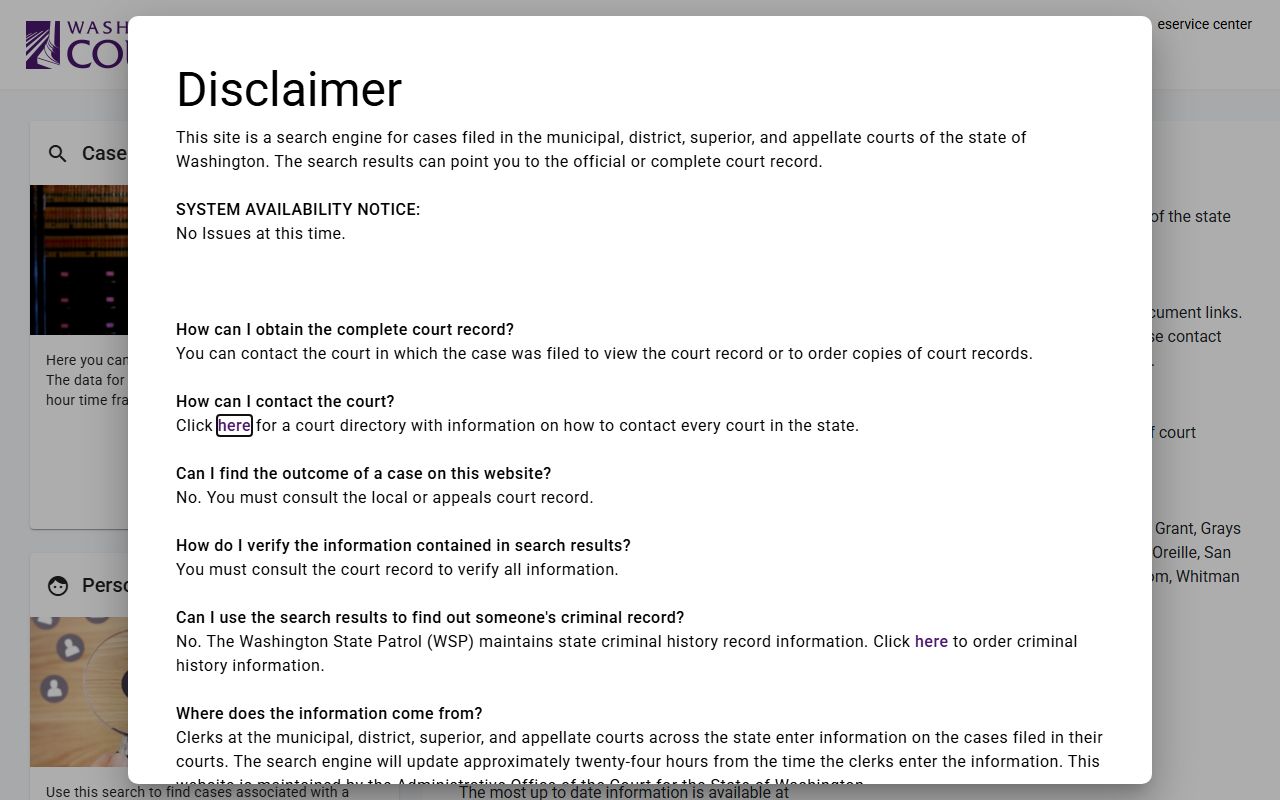
Keep in mind this tool shows state court records only. Federal bankruptcy filings require PACER or a courthouse visit.
Washington Bankruptcy Exemptions
Washington has opted out of the federal exemption system. Debtors must use state exemptions under RCW 6.15 for personal property and RCW 6.13 for the homestead. These laws set the limit on what property you can keep when you file. Assets above the exempt value can be liquidated in a Chapter 7 case to pay creditors.
Under RCW 6.15.010, each person may exempt $3,500 in household goods, furnishings, and provisions. The vehicle exemption is $15,000 per person for one motor vehicle. Tools and equipment used in your trade are exempt up to $15,000. Professionals such as doctors and lawyers get up to $15,000 for office equipment and library. There is a wildcard exemption of $10,000 that can be applied to any personal property other than personal earnings. Since July 23, 2023, each married person in a spousal community gets their own exemptions under RCW 6.15.010(1)(d). In practice this doubles the available protection for married couples who file together.
The homestead exemption under RCW 6.13 equals the median sale price of a single-family home in the county where the property sits, calculated as of the filing date. This reform came from ESSB 5408, which overruled the Ninth Circuit's holding in Wilson v. Rigby. In counties with high real estate values, this can mean substantial protection for homeowners.
Washington's bankruptcy exemption statute RCW 6.15 sets the property limits each debtor can protect from creditors when filing in Washington State.
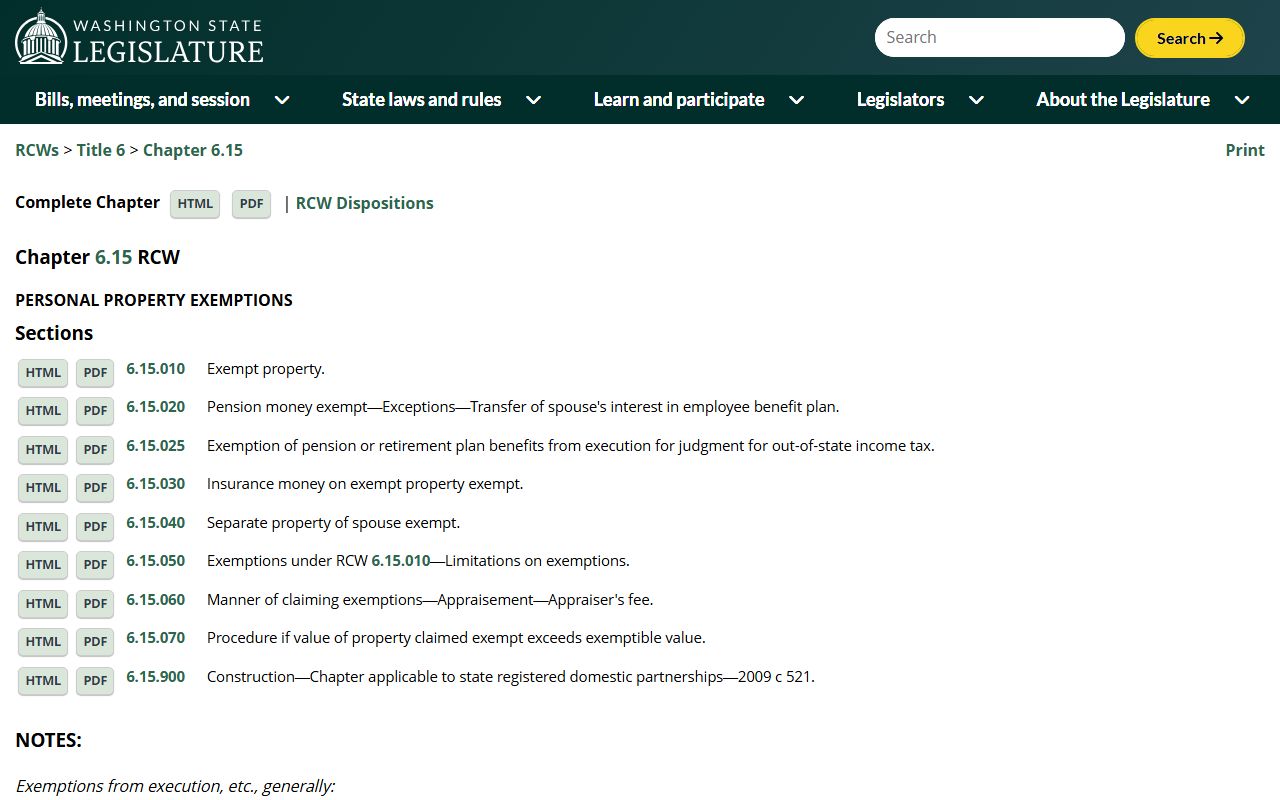
The statute was updated in 2023 to allow each spouse to claim a full set of exemptions independently, a major change for households filing together.
Washington Bankruptcy Chapter Types
Federal law provides several types of bankruptcy. The right chapter depends on your income, your debts, and what you are trying to keep. Most individual cases in Washington fall under Chapter 7 or Chapter 13.
Chapter 7 is liquidation bankruptcy. A court-appointed trustee sells any non-exempt assets and pays creditors from the proceeds. Most individual Chapter 7 cases are no-asset cases because debtors have little beyond exempt property. The process typically takes three to six months from filing to discharge. The filing fee is $338. Chapter 7 can discharge most unsecured debts such as credit cards and medical bills. It does not discharge student loans in most situations, most taxes, or domestic support obligations.
Chapter 13 is for individuals with regular income who want to keep their property and catch up on overdue payments through a three- to five-year repayment plan. You propose the plan and make monthly payments to a standing trustee, who distributes funds to creditors. The filing fee is $313. Chapter 13 is useful when you have non-exempt assets to protect or when you are behind on a mortgage and need time to make up the arrears. If you stay current on payments throughout the plan period, you get a discharge at the end.
Chapter 11 is for businesses and high-debt individuals. The filing fee is $1,738. Chapter 12 is for family farmers and commercial fishermen, with a $278 filing fee. All bankruptcy cases require a meeting of creditors under 11 U.S.C. Section 341. The trustee and any attending creditors can ask questions under oath. Appeals from Washington bankruptcy decisions go to the 9th Circuit Court of Appeals through its Bankruptcy Appellate Panel. The BAP offers a faster and less costly alternative to a full district court appeal.
Bankruptcy Records Filing Fees
Filing fees for bankruptcy cases in Washington are set by the Judicial Conference of the United States under 28 U.S.C. Section 1930. Both districts charge the same amounts. The current schedule took effect December 1, 2023. Chapter 7 costs $338 to file. Chapter 13 costs $313. Chapter 11 and Chapter 15 cases each cost $1,738. Chapter 12 costs $278.
Fee waivers are available for Chapter 7 filers who cannot pay. You submit an application to proceed in forma pauperis using the court's official form. The court reviews your income documentation to decide eligibility. Installment payment plans are also available. You pay online through Pay.gov or by phone with a credit card. Cashier's checks and money orders are accepted by mail. The courts do not take personal checks or cash. Registered Electronic Case Filing users must pay through the ECF system.
For record copies, PACER charges $0.10 per page with a $3.00 cap per document. The courthouse charges $0.50 per page for paper copies. Certification costs $12 for the first page. Searching court records costs $34 per search. Audio files of hearings cost $2.40 per file through PACER. These fees apply at all federal bankruptcy courts nationwide.
Note: Before filing, federal law requires completing a credit counseling course from an approved agency. Before discharge, debtors must finish a debtor education course. The court's website lists approved providers for both districts.
Historical Bankruptcy Records and Archives
Closed bankruptcy case files from before 2000 are generally transferred to the National Archives at Seattle. The facility is at 6125 Sand Point Way NE, Seattle, WA 98115-7999, phone 206-336-5132. The Research Room is open by appointment, Monday through Friday, 9 a.m. to 4 p.m. Files from both the Western and Eastern Districts of Washington are available there, arranged by docket number assigned at filing. Bankruptcy case files contain petitions from creditors, schedules of assets and liabilities, and court orders. Researchers should call ahead to confirm which files are available before visiting.
The Washington State Digital Archives covers Superior Court records from counties across the state but does not hold federal bankruptcy records. It is useful when you need related state court filings such as civil judgments, foreclosure proceedings, or probate records alongside a bankruptcy search. The Digital Archives holds over 21 million Superior Court case records from most Washington counties, with coverage typically starting in the 1950s to 1970s depending on the county. Contact the Puget Sound Regional Branch at (425) 564-3940 or the Northwest Regional Branch at (360) 650-3125 for help with specific county collections.
Free Legal Help in Washington
Several programs connect Washington residents with free or low-cost legal help for bankruptcy. Most are income-based. These services focus on civil legal matters and do not handle criminal cases.
The Washington State Bar Association provides a resource page for finding legal help statewide. The CLEAR program (Coordinated Legal Education, Advice and Referral) takes calls from low-income Washington residents dealing with civil legal problems, including bankruptcy and consumer debt. Outside King County, call CLEAR toll-free at 888-201-1014, Monday through Friday, 9:15 a.m. to 12:15 p.m. King County residents call the 211 Legal Referral and Information Hotline, Monday through Friday, 8 a.m. to 6 p.m. Seniors statewide can call 1-888-387-7111 for the CLEAR senior line.
The Office of Civil Legal Aid is a state agency that funds civil legal services for low-income Washingtonians. OCLA contracts with attorneys statewide. The Northwest Justice Project is its largest provider and operates through the CLEAR intake system. Attorneys funded by OCLA can give advice, help with court paperwork, or take on full representation depending on availability.
Washington's Office of Civil Legal Aid connects low-income residents with attorneys across the state who handle civil legal problems including debt and bankruptcy.
Call 1-888-201-1014 to reach the CLEAR intake line or apply online through the Northwest Justice Project website.
The Washington State Attorney General's Office handles consumer protection and provides information on debt collection rights under RCW 19.86. Call 1-800-551-4636 in-state or 206-464-6684. The AG's office warns residents about debt relief scams and offers free publications on credit reports, identity theft, and debt collection rights in English and Spanish. Complaints against debt collectors can be filed online at atg.wa.gov/file-complaint.
Browse Washington Bankruptcy Records by County
Washington bankruptcy cases are filed in federal court, but your county determines which district and division handles the case. Select a county below for courthouse contact info, local Superior Court details, and resources for finding bankruptcy records in that area.
View All 39 Washington Counties
Washington Bankruptcy Records in Major Cities
Residents of Washington's larger cities file bankruptcy cases in the federal court for their district. Select a city below for courthouse details, local resources, and information on how to find bankruptcy records near you.